

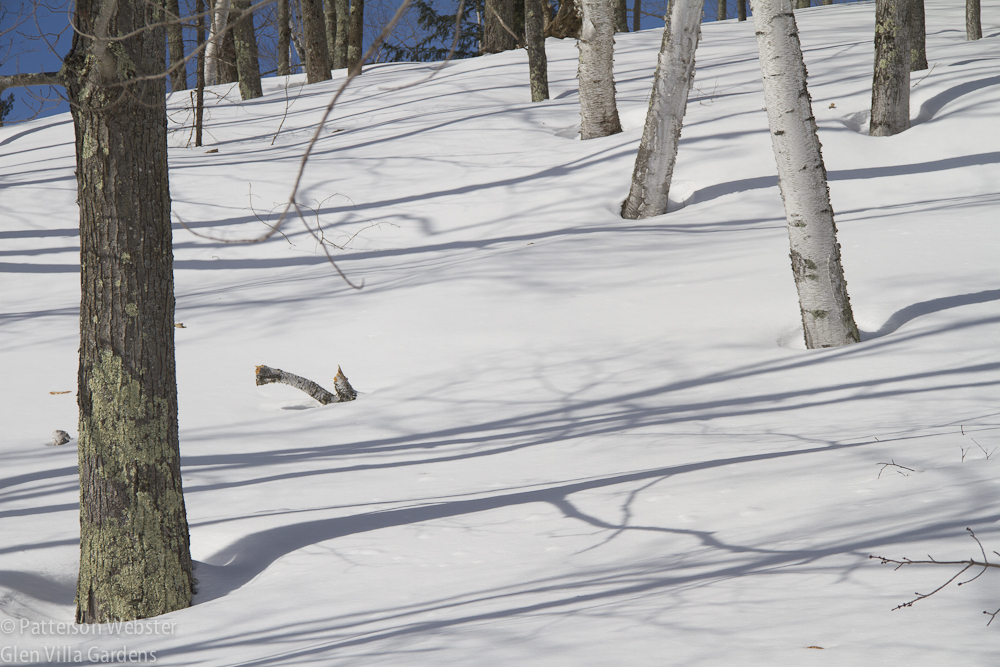
January has brought some bright blue-sky days, with strong sunlight casting shadows on the snow. These dark lines are a common winter sight in Quebec, and in my garden Glen Villa, in Quebec’s Eastern Townships.
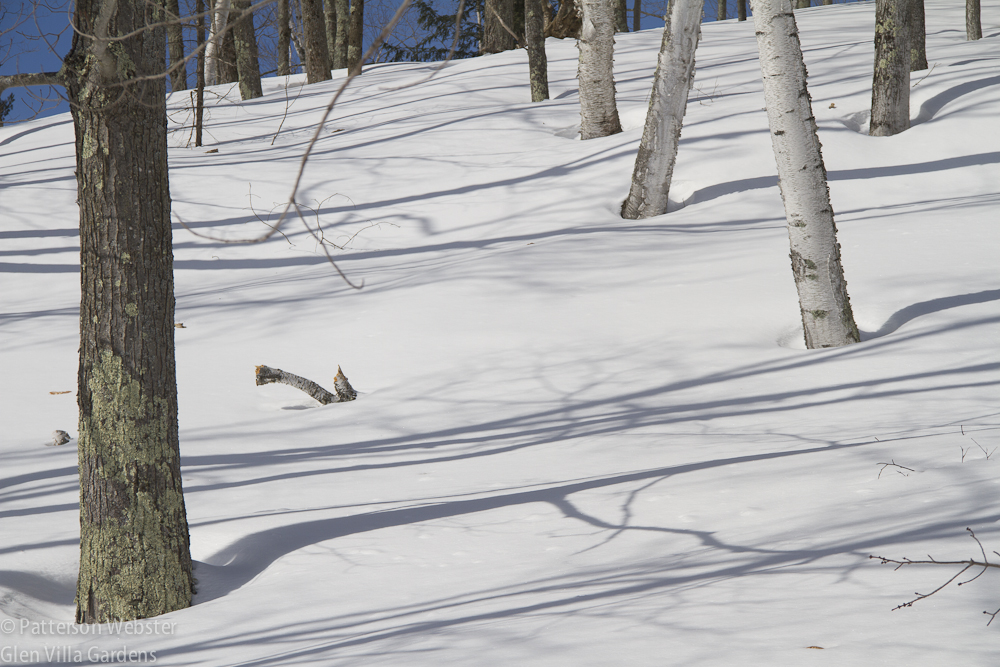
Tree trunks cast shadows across the snow. I could say the shadows are like lines on a blank page, except that they aren’t.
Usually, these shadows are simply a visual echo of the real thing, but occasionally they appear more substantial than the object itself. A bench with an open-work seat becomes solid in its shadow.
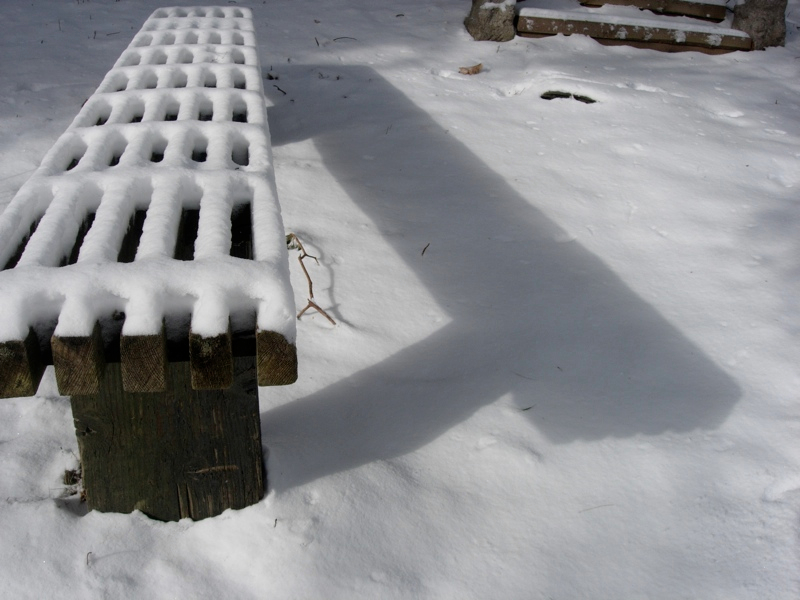
Ok, I know that the side of the bench is shadowed, not the top. Even so, I was surprised by the contrast.
Shadows offer opportunities in garden design that few of us take full advantage of. An ordinary sight can become mysterious when it is patterned with shadows.
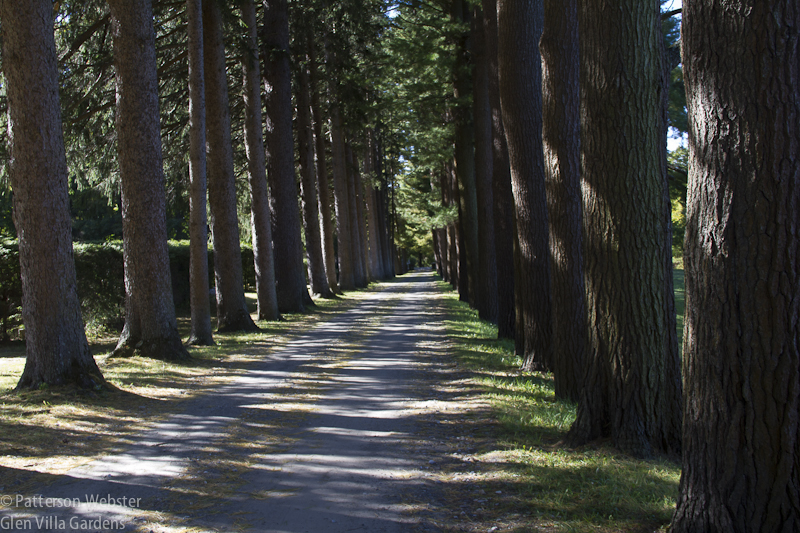
Shadows crisscrossing make this road at Naumkeag more inviting that it would be without them.
Shadows can create many different moods and responses. They can be inviting, or repellant, or downright scary.
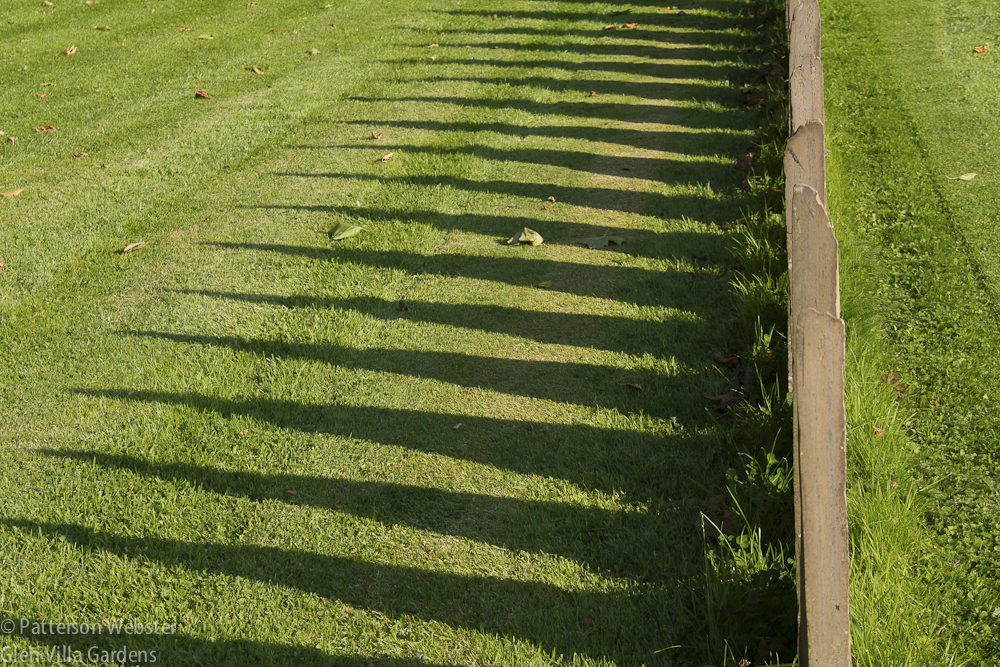
A low fence in The Garden of Cosmic Speculation becomes a shadowy weapon towards the end of the day, when shadows are long.
They can even be amusing, or at least more interesting than the thing itself.
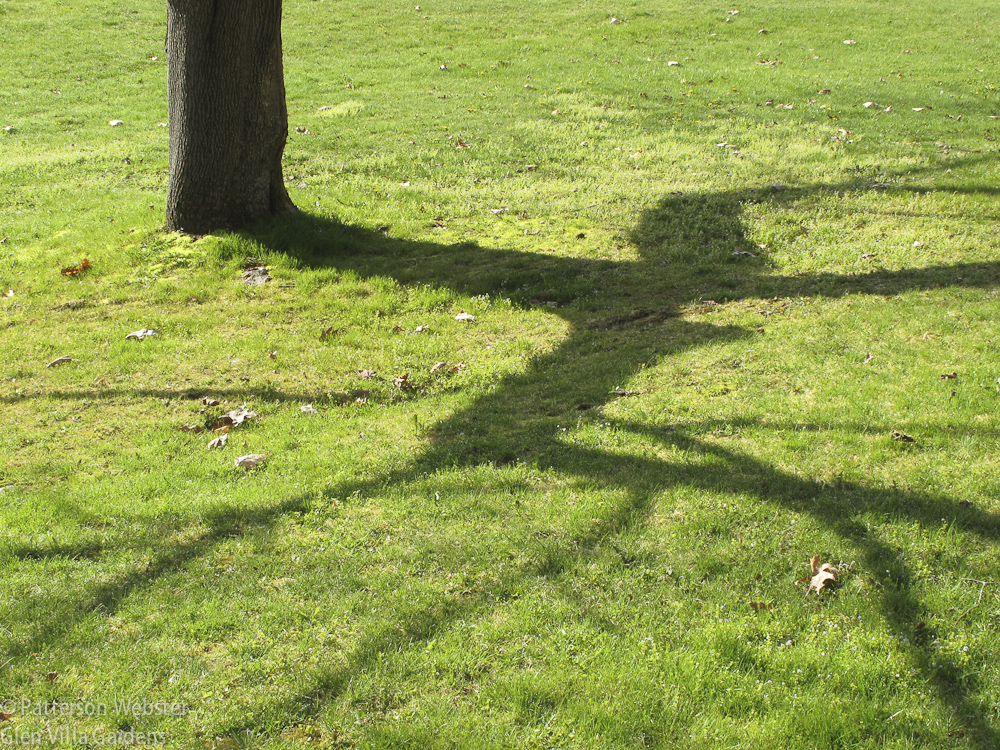
This shadow of tree branches reminds me of a multi-legged insect dancing across the grass.
Shadows are a crucial part of In Transit/En Route, an art installation I created in 2011. (It’s an artwork to be experienced rather than explained, but if you want to know more, you can read about it here, and here, and here.) A path leads to a clearing in the woods where the shadow of a dead tree marks the hour. In summer the shadow’s mark is accurate. Not in winter, though — shadows ignore Daylight Savings Time.
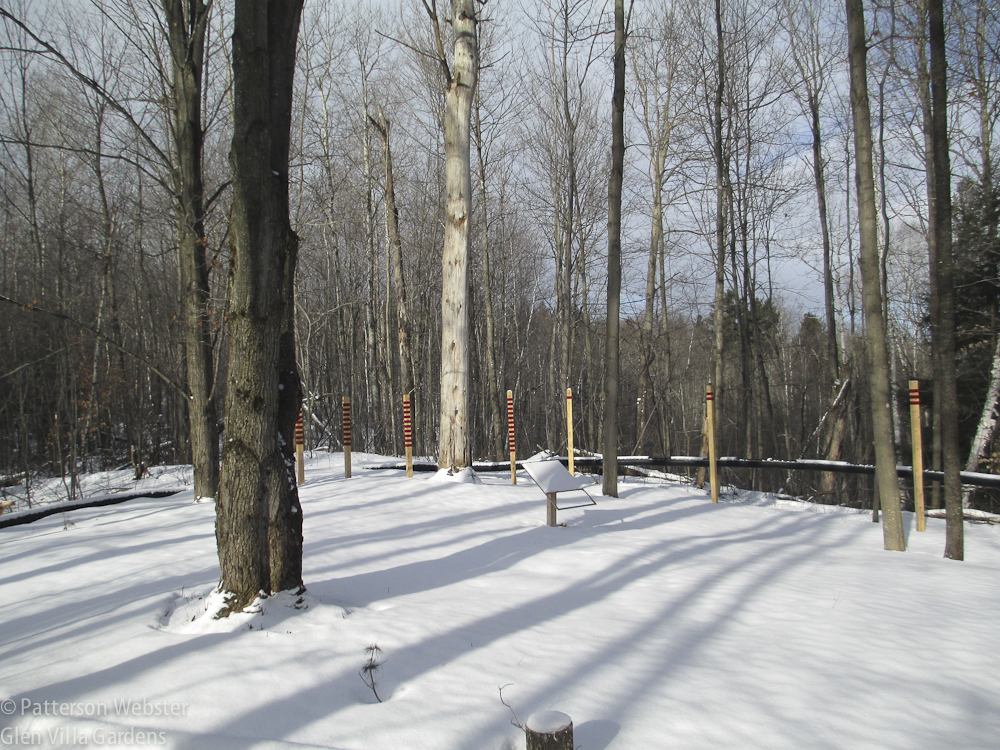
The shadow of the tall tree in the background falls onto posts painted with red lines. The number of lines indicates the hour.
The idea of a shadow is integral to Tree Rings, my most recent sculpture. The tree that was, is no more. But its shadow remains, both literally and figuratively.
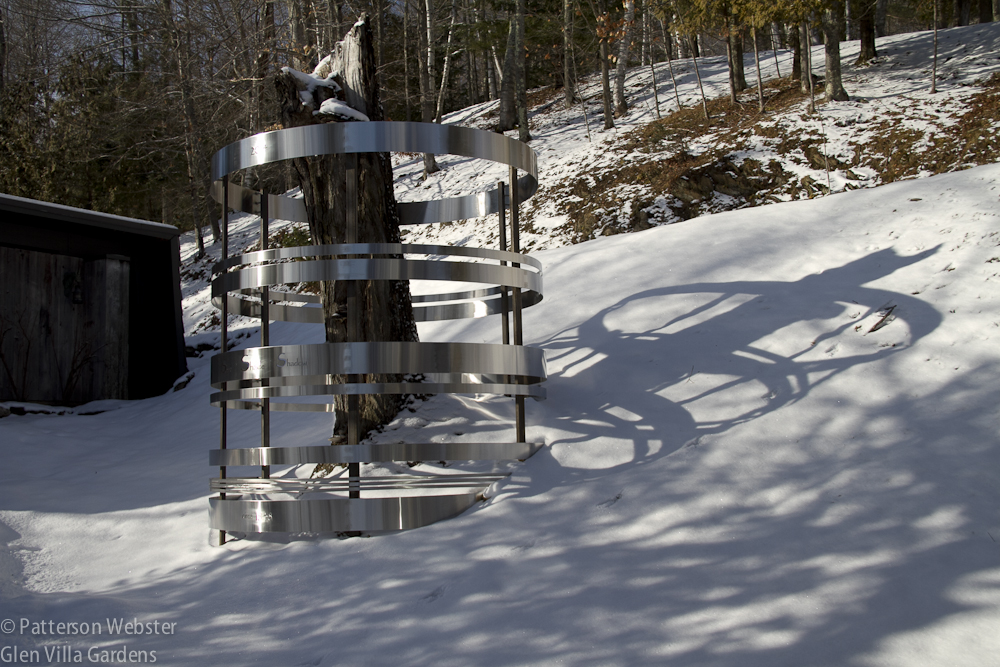
The different widths of stainless steel bands that circle the tree trunk suggest the way the tree grew, more in good years, less in bad.
Three words laser-cut into the stainless steel rings make this idea explicit.
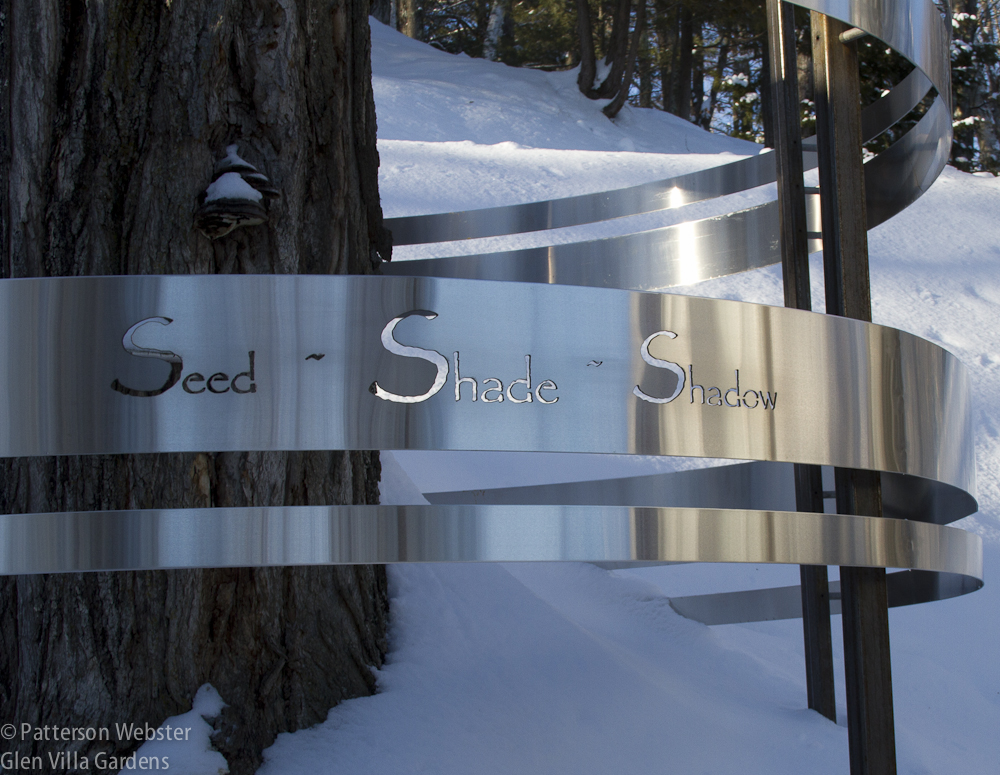
Seed, Shade, Shadow: the life of this tree in three simple words.
Shadows aren’t substantial. They don’t last, they come and go with the sun. But while they aren’t always present, they still can have a lasting effect.
Do shadows play a part in your garden? Have you used them deliberately or are their effects accidental?






It is simply that time of year for shadow dancing!
Yes, especially under the moonllght.
Those of us who live in snowy climates are blessed with dramatic shadows. (I especially love the moon shadows of winter nights.) I hadn’t thought about incorporating shadows into garden design, but now I will. (The shadows of your tree ring sculpture are stunning.)
I also adore the moon shadows — so stunning on a winter’s night. Thanks for the compliment about Tree Ring’s shadows. I had no choice about where or how to position the sculpture — it had to be where the tree trunk was — and photographing it is difficult because of so many extraneous elements, including shadows from the garage nearby. If I used photoshop, I suppose I could remove the things I didn’t like, but that feels like cheating!
Excellentes photos. Comme Jean ci-dessous, je n’ai jamais tenu compte des ombrages dans le jardin mais je vais devroir réviser mon tir!
Hier soir les ombrages était magnifiques!
I haven’t really thought about shadows in my garden, other than how they limit the sunlight exposure of the plants below. But seeing your photos, new possibilities occur to me.
I’m intrigued, Jason. I hope you will implement whatever new possibilities have occurred, and then show them on your blog.
Great minds? http://veddw.com/general/shadows/
Are we shadow boxing?